- Category: Brokerage Business
White Label and Full-Stack : Choosing the Right Brokerage Path
Frequently Asked Questions
What is the difference between a white-label and a full-stack brokerage?
A white-label brokerage licenses an established provider's platform and infrastructure to launch quickly at low upfront cost, while a full-stack (licensed or turnkey) brokerage owns more of the technology and licensing, offering greater control at higher cost. White-label suits early launch and market testing; full-stack suits scale and differentiation. The right model depends on budget, control needs and growth stage.
Is white-label or full-stack cheaper for a brokerage?
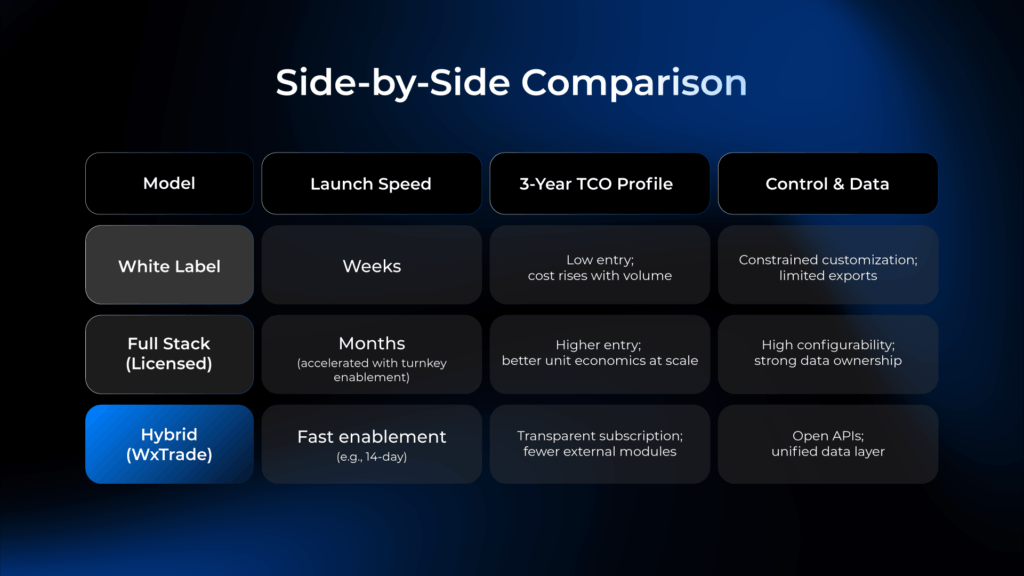
White-label is cheaper upfront and in the early stages, but its cost pattern rises with volume through per-client or revenue-share fees, whereas full-stack has higher initial cost but lower marginal cost at scale. Over a three-year total cost of ownership, there is an inflection point where full-stack becomes more economical. The cheaper option therefore depends on how large and fast the brokerage grows.
When should a brokerage switch from white-label to full-stack?
A brokerage should consider moving to full-stack when it approaches the inflection point where white-label's volume-based fees exceed the cost of owning the stack, and when it needs more control over product, workflow and data. Growing client numbers, multi-region expansion and the desire to differentiate all push toward full-stack. The timing is a business decision based on scale, margins and strategic control.
How do white-label and full-stack models differ in control and data?
Full-stack gives a brokerage full control over product features, workflows and direct access to its data, while white-label constrains customisation and can limit data ownership and portability to the provider's terms. This matters because control and data access affect how freely a broker can differentiate and how easily it can migrate later. Brokers valuing independence tend to favour full-stack as they mature.
Which model scales better for a multi-region brokerage?
Full-stack generally scales better for multi-region operations because it gives control over technical architecture and the ability to adapt to different jurisdictions, whereas white-label scaling depends on the provider's coverage and terms. White-label can still support early multi-region entry cheaply, but as regional complexity and volume grow, the control and economics of full-stack usually become more favourable.