- Category: Brokerage Business
Brokerage Integration: Plug in Growth, Not Complexity
Frequently Asked Questions
What is brokerage integration?
Brokerage integration is the process of connecting the separate systems a broker relies on (trading platforms, payment gateways, KYC and RegTech tools, CRM and reporting) so they operate as one coordinated ecosystem. Modern brokerages increasingly do this through a marketplace of pre-built, certified apps rather than bespoke custom builds. The goal is to reduce engineering effort and operational risk while adding capabilities faster.
What is the hub-and-spoke model in broker integration?
The hub-and-spoke model places a central platform (the hub) at the core of the brokerage, with individual services such as payments, liquidity, KYC and marketing connecting to it as spokes through standard APIs. This blueprint replaces tangled point-to-point connections, so each integration is managed once against the hub rather than against every other system. It simplifies maintenance and makes adding or replacing a provider far less disruptive.
What types of integrations does a brokerage need?
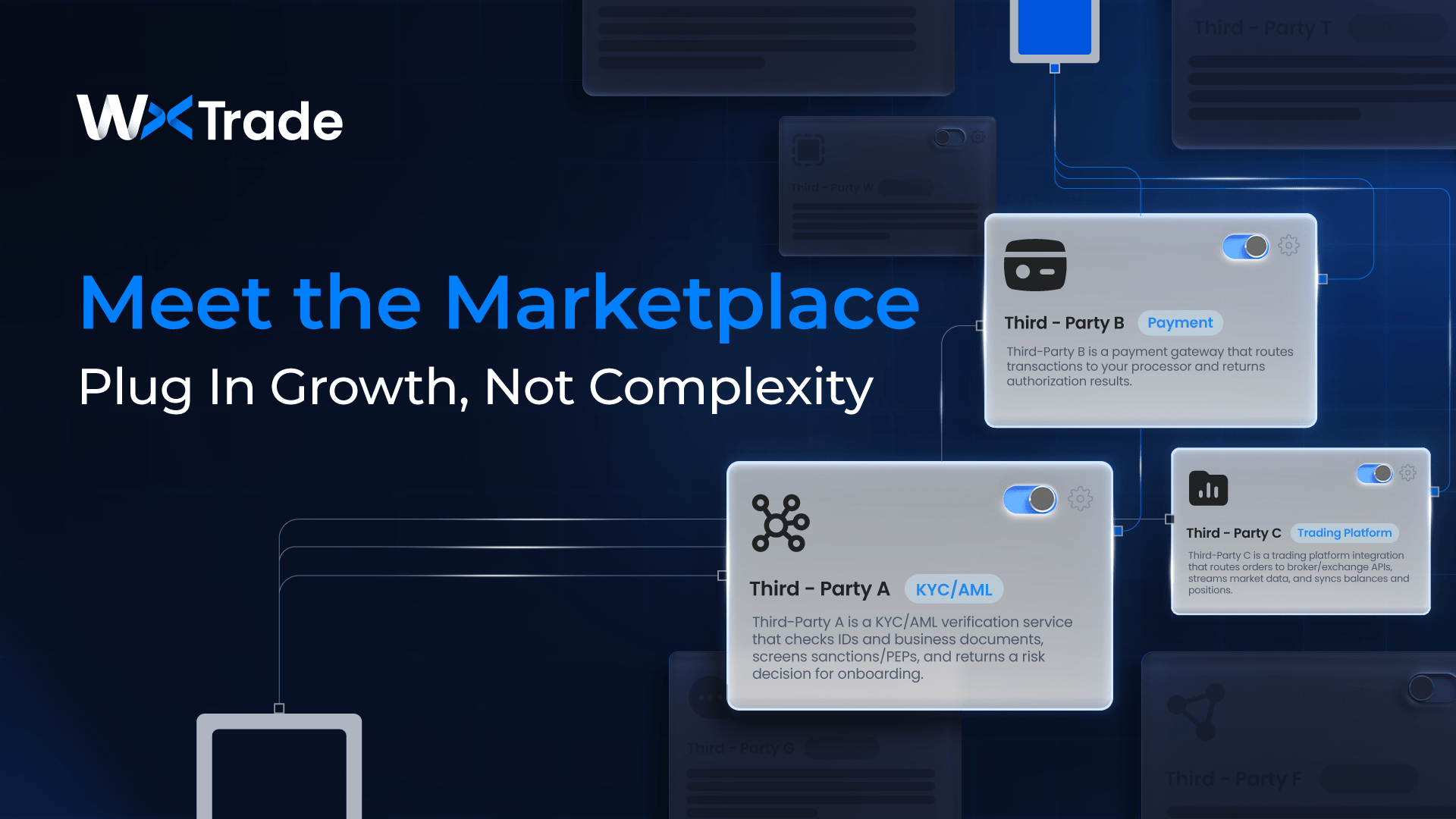
Core brokerage integrations fall into a few categories: payments (PSPs and gateways), KYC/AML and RegTech, trading platforms and liquidity, CRM with client portal and IB tools, and risk, reporting and compliance systems. Growth-oriented brokers add value-add integrations such as marketing automation and analytics. Grouping integrations this way helps a broker prioritise which connections are essential at launch versus which support later scaling.
How does marketplace certification work for broker integrations?
Marketplace certification verifies that a third-party app meets technical, performance, security and compliance standards before a broker can plug it in. Technical certification confirms the integration performs reliably under load, while security and operational checks confirm it handles data safely and is production-ready. Certification gives brokers confidence that a listed integration will not introduce instability or regulatory exposure.
How is API security handled when partners integrate with a brokerage?
API security relies on strict access control, authenticated and scoped API keys, encryption in transit, and least-privilege permissions so each partner can access only the data it needs. Because integrations expose sensitive client and financial data, brokerages also monitor API activity and enforce rate limits and audit logging. These basics protect the platform even as the number of connected partners grows.