- Category: Brokerage Business
Social Trading Platforms: How Copy Trading Works and What the Broker Runs Behind It
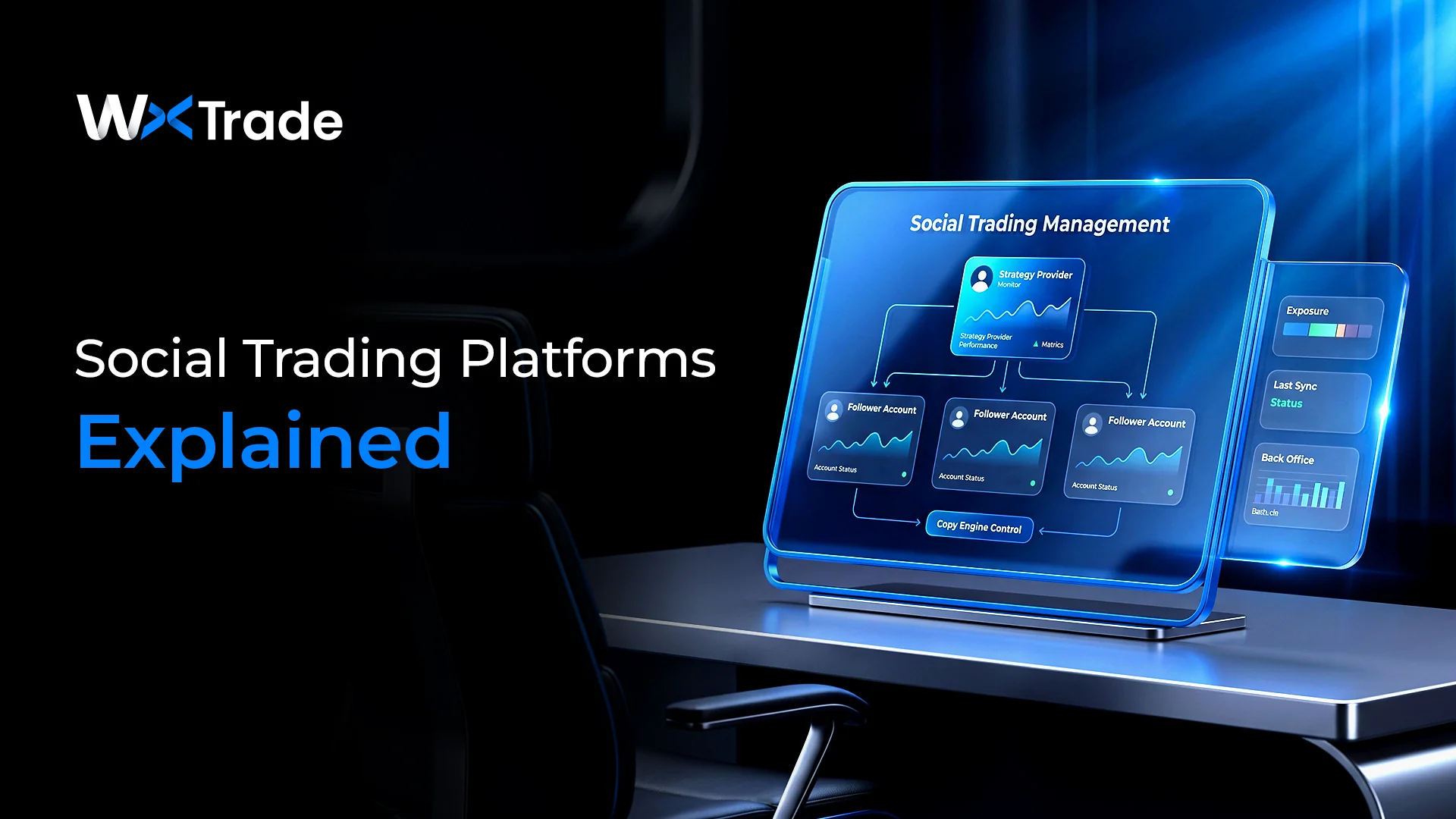
A social trading platform is a trading service that shows clients what other traders are doing (public profiles, performance statistics, feeds and rankings) and usually lets a client copy a chosen trader automatically. Three systems do the work: a social layer that helps followers pick a strategy provider, a copy engine that turns each of the provider's trades into a proportionally sized order on every follower's account, and a payout ledger that pays providers through subscriptions, platform payments or performance fees. The brokerage behind the platform executes the copied orders, holds both sides' accounts and carries the regulatory classification. In the UK and the EU, automatic copying of another trader's trades is treated as portfolio management; in the US, a strategy provider paid to advise on retail forex accounts can fall within the definition of a commodity trading advisor.
This guide starts with what the trader sees, then covers what the brokerage operates: how the copy engine sizes and synchronises trades, how strategy providers are paid, how regulators classify each model and which systems an operator has to run.
How social trading works for the trader
For the client, a social trading platform begins as a directory of other traders. Each strategy provider has a public record, and the follower decides whether to read, follow or copy. The signals list built into MetaTrader 5 is a representative example: for every signal it shows growth since registration, balance, profit, a reliability score, the number of weeks traded, the current number of subscribers and the broker server the provider trades on.
Once a follower starts copying, the platform places the trades. The UK Financial Conduct Authority (FCA) describes the usual arrangement on its copy trading page: copying "typically involves setting a proportion of funds to execute the trades of the copied trader from the allotted funds", some platforms let followers limit risk with stop-loss orders, and the follower can disconnect the funds and close the copy relationship.
Retail brands describe the same mechanism in their own terms. eToro's Form F-1 registration statement, filed with the US Securities and Exchange Commission (SEC) in March 2025, defines its CopyTrader technology as a way of "assigning some of the user's capital to proportionally mimic the portfolio of another investor".
Social trading, copy trading, signals, PAMM and MAM compared
Five models are marketed under the social trading label. They differ on the question that matters to the follower, the broker and the regulator alike: who decides each trade.
- In a social feed, and in a signal service that asks for confirmation, the follower still places or approves every order.
- In automatic copy trading, the copy engine places the order on the follower's own account, scaled to that account's balance.
- In PAMM and MAM, a money manager trades a master account and the platform allocates the result to investors.
The table below compares the five models by who decides each trade, where the position sits and what the follower controls.
| Model | Who decides each trade | Where the position sits | What the follower controls |
|---|---|---|---|
| Social feed | The follower, who reads shared ideas and places every order | Follower's own account | Every order; nothing is automatic |
| Signal with confirmation | The provider proposes; the follower confirms each trade before it is sent | Follower's own account | Each trade, before execution |
| Automatic copy trading | The provider; the copy engine replicates each trade with no further action | Follower's own account, scaled to its balance | Share of funds allocated, stop-loss settings and when to stop copying |
| PAMM | A money manager trading one master account | Pooled master account; profit and loss shared by each investor's stake | Deposits and withdrawals; trading sits with the manager |
| MAM | A money manager trading one master account | Segregated client sub-accounts, allocated by equity, balance, fixed lots or percentage | Funding of the sub-account; trading sits with the manager |
Automatic copy trading is the model that guidance from the European Securities and Markets Authority (ESMA) and the FCA addresses directly, and the rest of this guide concentrates on it.
How the copy engine sizes and synchronises each trade
The copy engine decides how large each follower's copy of a trade is. A fixed one-to-one ratio is the simplest design and the riskiest. According to MetaQuotes, which explains why its signals service sizes by deposit share, a provider with a USD 30,000 deposit can sit out a temporary drawdown on a large position that would stop out a USD 10,000 follower copying at 1:1.
MetaTrader 5 therefore multiplies the provider's volume by the ratio of the two balances, after applying the share of the deposit the follower allows for copying and converting the deposit currency. In the platform's own example, a follower with EUR 8,000 who allows 50% of the deposit, copying a provider with USD 10,000 at a EURUSD rate of 1.2000, receives 0.48 lots for every 1 lot the provider trades: EUR 4,000 is USD 4,800, and 4,800 divided by 10,000 is 0.48.
Two further adjustments explain why a follower's trades are rarely an exact miniature of the provider's. When the follower's leverage is lower than the provider's, the ratio is reduced in the same proportion: in a worked example published by MetaQuotes, a follower on 1:50 copying a provider on 1:100 has the ratio halved. The final percentage is then rounded by a multistep algorithm, which in the same example turned a computed 169.33% into a 160% copy ratio.
Illustrative model · balance-ratio copying
How large is the follower's copy?
Proportional sizing as MetaTrader 5 documents it: the follower's allowed share of balance divided by the provider's balance, cut further when the follower's leverage is lower than the provider's. Both accounts are in USD here, and the copied size is rounded down to a 0.01-lot step as a simplifying assumption.
Inputs
Copied trade
Ratio = (2,000 × 50%) ÷ 25,000 = 4.00%
Leverage: follower 1:100 is not below provider 1:100, so no cut
Copy = 0.30 × 4.00% = 0.012 lots, rounded down to 0.01 lots
Below the 0.01-lot step in this model: the trade cannot be copied at a proportional size.
Teaching model, not a MetaTrader replica. MetaTrader also converts deposit currencies and applies its own multistep rounding to the ratio; other copy engines use different sizing modes.
The model shows the effect on a small account. With a 4% copy ratio, a 0.30-lot trade becomes 0.012 lots, and an engine that trades in 0.01-lot steps has to round that copy away from the exact proportion. Followers much smaller than the provider receive copies that are either distorted or too small to open.
Synchronisation rules matter as much as sizing. In MetaTrader 5, pending orders on the provider's account are not copied until they trigger, a follower cannot copy some of the provider's positions while ignoring others, and a copied position the follower closes manually is reopened at the next re-synchronisation. Because different brokers can have different price flows, MetaQuotes recommends copying on the same server, meaning the same broker, as the provider; on another broker's prices, stop levels may trigger earlier on the follower's account than on the provider's.
For a broker, each of those rules becomes a configuration decision: where the copy engine runs, whether providers and followers must hold accounts on the same trading server, what minimum account size keeps small followers from being rounded to nothing, and how much slippage the engine tolerates before a follower falls out of sync.
How strategy providers get paid
Payment design is where a social trading platform becomes a commercial question and a compliance question at once. Published terms show three different models:
- Subscription fees. On the MQL5 signals service, the follower pays for the whole subscription period in advance; the provider receives the fee a week after the period ends, less a 20% commission retained by the service, under MetaQuotes' published rules.
- Platform payments. eToro's registration statement says its Popular Investors "are compensated as their investment strategy is copied by more users on our platform", building "a revenue stream from eToro" rather than from followers directly.
- Performance fees. Managed-account models such as PAMM can pay the manager a share of profits measured against a high-water mark, so the manager is paid only on new gains.
Each model creates an incentive the operator has to supervise. ESMA's 2023 supervisory briefing on copy trading warns that conflicts of interest "can arise in particular from the structure of the payment made to the traders whose trades are being copied", not least because a copied trader "could be paying the firm as a client and be receiving remuneration" for sharing trades. According to ESMA, the remuneration of copied traders who are not employees can still need to comply with the MiFID II remuneration requirements.
Payment tied to the number of copiers also invites manipulation. eToro's registration statement discloses past instances of users "fraudulently copying each other's positions to increase the fees they might receive" under its Popular Investor program. A broker that pays providers per copier or per unit of copied equity needs surveillance for reciprocal copying between linked accounts, not only for conventional trading abuse.
How regulators classify copy trading
The classification turns on whether the follower acts before each trade. Two points carry across the main regimes:
- In the EU and the UK, automatic execution of another trader's signals is portfolio management, whatever limits the client sets.
- In the US, where the National Futures Association (NFA) registers advisers under Commodity Futures Trading Commission (CFTC) rules, attention shifts to the person giving the advice: a paid strategy provider on retail forex accounts can be a commodity trading advisor (CTA).
| Regulator | Position | What it means for the broker |
|---|---|---|
| ESMA (EU), March 2023 briefing | Automatic execution without client action is portfolio management; if the client acts before each trade, advice or order transmission may apply instead. | Portfolio management authorisation, suitability checks and controls on how copied traders are paid. |
| FCA (UK) | Copy trading is portfolio or investment management where no manual input from the account holder is clear; client-set limits do not change that. | Portfolio management permission, suitability assessment and periodic reports to clients and regulators. |
| NFA and CFTC (US) | A CTA advises others for compensation on retail off-exchange forex, among other products; registration exemptions sit in CFTC Regulation 4.14. | Paid strategy providers may need CTA registration, and NFA membership if they exercise discretion over customer accounts. |
ESMA's briefing states that it does not constitute new policy. It sets out how ESMA and the national regulators expect existing MiFID II rules to apply to copy trading, and it includes indicative questions that supervisors can put to firms offering the service.
What the brokerage runs behind a social trading platform
From the operator's side, a social trading platform is a set of systems and controls around the trading server rather than a single feature. The working list has six parts:
- The copy engine: sizing rules, leverage and currency adjustments, rounding, synchronisation and slippage tolerance, and whether it runs on the same trading server as the provider accounts.
- The provider programme: entry criteria, the statistics published on each profile and the rules for removing a provider.
- The payout ledger: subscription, platform or performance payments, with a record of how each payment was calculated, because remuneration structures are a supervisory focus.
- Surveillance: checks for reciprocal copying between linked accounts as well as for conventional trading abuse.
- Permissions: the authorisation the service needs in each market, which in the EU and UK means portfolio management when copying is automatic, together with the suitability checks that come with it.
- Client records: onboarding, funding and account data for every provider and follower, held in the broker's back office.
The last item is where systems a broker already runs do most of the work. Whichever copy engine a broker licenses, provider and follower accounts pass through the same onboarding, funding and account records as any other client. In WxTrade's back office, for example, deposits, withdrawals, identity verification and bank-account checks queue on one pending-approval panel, and the trading-account list shows each login's group, balance, equity, margin and leverage for the selected trading server.
Whether a copy programme pays for itself is a separate calculation. A companion analysis of whether copy trading is profitable for brokers covers revenue models and the B-book exposure that builds when many followers copy the same trade.
Frequently asked questions
What is social media trading?
Social media trading means acting on trades and ideas shared on social networks rather than through a platform's copy function. ESMA's copy trading briefing addresses the case directly: where a client copies trades seen on social media and then gives the order to the firm, the firm is likely to be providing execution services only, although the shared trades could still qualify as investment advice from the person who posted them.
Is social or copy trading illegal?
Copy trading is not banned as such in the EU or the UK, but automatic copying is an activity that needs authorisation there. In the US, access is narrower: eToro stated in its March 2025 SEC registration statement that "CopyTrading is only available to our U.S. users for cryptoasset trading". A strategy provider paid to advise on US retail forex accounts needs to register as a commodity trading advisor unless it meets one of the exemptions set out in CFTC Regulation 4.14.
Why didn't my trade copy?
On MetaTrader 5, several documented synchronisation rules can stop a copy without any fault. By default, copying does not start while the follower's account holds open positions or pending orders of its own, and if the provider's positions show a floating profit at the start, the follower is offered the option to wait. During copying, if the execution price moves beyond the follower's slippage setting, the platform widens the tolerance by half a spread and retries; a second requote leaves the two accounts unsynchronised until the platform tries again.
Can I copy from a demo account?
Not on the MQL5 signals service: its rules allow signals to be created only from a real account. The same rules bar a provider who is a representative, employee or affiliate of a brokerage company from offering paid signals, a point a broker designing its own provider programme has to settle for its platform.
Do I need a VPS?
For MetaTrader 5 signals, the follower's trading account must stay switched on and connected to the server for copying to continue, so MetaQuotes suggests renting a virtual private server (VPS), which it says can also improve copying quality by reducing network latency. A copy engine that runs on the broker's own infrastructure removes that dependence on the follower's terminal.