- Category: Brokerage Business
MT5 White Label Cost in 2026: What Brokers Really Pay to Run MT5 Under Their Own Brand

An MT5 white label in 2026 is a sub-licence rented from a firm that holds its own MetaTrader 5 server licence. MetaQuotes stopped processing new white labels in late September 2022, according to trade-press reports, and it sells MT5 to brokers as Entry, Standard and Enterprise server licences. On the vendor planning ranges set out below, a sub-licence costs about USD 7,500–25,000 to set up, and its platform fee of USD 1,000–5,000 a month covers only part of the monthly bill before liquidity, CRM, hosting, support and compliance are added. An MT4 white label is a narrower purchase. MetaQuotes states that MetaTrader 4 licences are no longer available for purchase, and it stopped issuing new MT4 servers in January 2018, so any MT4 white label offered today runs on an older main-label server at a price set by that server’s holder. For a new brokerage, the open routes are an MT5 sub-licence, an own MT5 server or a trading platform outside MetaQuotes.
Key Takeaways
An MT5 white label allows brokers to use MetaTrader 5 under their own brand, but the phrase itself is misleading in 2026. MetaQuotes stopped issuing new white labels in late September 2022. What brokers purchase today is a sub-licence from an existing main-label holder, not a direct MetaQuotes product. Planning ranges published by vendors such as B2Broker and Quadcode place one-time setup costs at approximately USD 7,500–25,000 and recurring monthly fees at roughly USD 2,700–11,000 – yet these figures describe only the trading platform layer, not full brokerage infrastructure. MetaTrader is globally recognised and trusted by retail and institutional traders, which sustains demand. WxTrade, a broker technology platform for forex and CFD brokerages, addresses the operating layer – CRM, client portal, back office and payments – that sits around whichever terminal a broker selects.
- MT5 white label solutions reduce launch costs and technical complexity, but the published platform fee covers the narrowest line on the bill. Costs vary depending on CRM, compliance, hosting and liquidity requirements.
- MetaQuotes now meters pricing on active accounts only (TradeInformer, September 2024). Demo accounts are not charged, which means the cost curve accelerates as conversion from demo to funded accounts improves.
- This active-account model clashes with prop trading firms that run thousands of demo-based evaluations generating minimal billable activity for the platform, bridge or liquidity provider.
- Total first-year cost for an mt5 white label solution typically falls between USD 50,000 and USD 120,000 once the operating stack is included, with main-label alternatives estimated at USD 150,000–300,000 (Finance Magnates estimates, 2025).
- The 20–25 per cent MetaQuotes price increase from January 2025 narrows the gap between sub-licence and full metatrader server routes, making a dedicated server license increasingly rational at scale.
What an MT5 White Label Really Is in 2026
An mt5 white label in 2026 is a sub-licence obtained through another broker or technology provider’s main-label MetaTrader 5 licence. It is not a standalone MetaQuotes product. The white-label operator typically receives manager and dealer access only – no ownership of the MetaTrader 5 admin server, no root-server settings and no direct MetaQuotes relationship. White label providers handle server maintenance and technical support under this arrangement.
The principal licence holder controls the MetaTrader 5 server infrastructure, liquidity connectivity, hosting (often in financial data centres such as Equinix LD4 in London or Equinix NY4 in New York) and sometimes payment systems and liquidity provider contracts. The white-label operator runs the brokerage brand, manages client acquisition, sets risk management policies and handles day-to-day trading operations on top of that shared trading infrastructure.
An MT5 white label includes a branded trading platform with branding, liquidity connections, and risk management tools. MT5 supports trading in multiple asset classes including forex, stocks, commodities and cryptocurrencies. Customisation in a white label setup is limited mainly to branding elements – company logo, colour schemes and client-facing interfaces – while a white label solution can allow brokerages to focus on marketing and client acquisition instead of technical management. White label arrangements simplify the technical work involved in broker operations, but this structure affects both cost and backend control: pricing flows through the principal’s MetaQuotes licence, and configuration changes may require the principal’s cooperation. Brokers can maintain full branding control with an MT5 white label, preserving brand identity across mobile trading applications, web and desktop terminals.
Licensing Timeline: Why Old MT5 White Label Answers Are Now Wrong
The cost of an MT5 white label cannot be understood without the licensing history that produced the current market structure. Most published guides repeat figures from eras that no longer apply.
- Pre-February 2021: MetaQuotes sold MetaTrader 4 and MetaTrader 5 licences via a one-off fee model. MT5 Server licence fees ranged from USD 20,000 to USD 250,000. MT4/MT5 white-label setup fees sat at USD 5,000–7,500. Terminals (desktop, web, mobile) were sold separately, keeping monthly fees lower (Match-Trade Technologies, May 2021).
- February 2021: MetaQuotes moved MT4/MT5 White Label and MT5 Server products from a licence-fee model to a subscription model. Large upfront licence fees were waived, but desktop, web and mobile terminals became compulsory. MT5 white label monthly fees rose from about USD 2,000 to about USD 3,000 per month. Full MT5 Server licences started from approximately USD 5,000 per month for a 1,000-account basic package.
- Late September 2022: MetaQuotes told technology partners its White Label product was unavailable in its own support-site app store and that no new white labels would be processed “until further notice” (FX News Group, 29 September 2022). MetaQuotes has restricted MT5 white label licensing for new brokers, and new issuance has not resumed. Existing arrangements continue.
- Consequence: A new broker cannot obtain a fresh MT5 white label direct from MetaQuotes. The two remaining routes are a sub-licence from an existing main-label holder or a full MT5 server licence.
- December 2024: MetaQuotes notified clients that licensing fees would rise from 1 January 2025 (Finance Magnates, 6 December 2024). The increase landed at 20–25 per cent. Finance Magnates reported, on figures from firms that asked not to be named, that support for one MetaTrader licence covering desktop, web and mobile averages about USD 10,000 per month; brokers licensing both MetaTrader 4 and MetaTrader 5 moved to roughly USD 20,000–25,000 per month; and comprehensive packages can exceed USD 50,000 per month. White labels add approximately USD 3,000–5,000 per month.
This timeline explains why historic narratives about inexpensive MT5 white labels understate 2026 costs and why owning a full MT5 Server licence increasingly becomes the rational route for many brokers expecting business growth in active-account volume.
MT4 White Label in 2026: What Is Still for Sale and What It Costs
A MetaTrader 4 white label is the same sub-licence arrangement on the older platform, and in 2026 it is the more constrained purchase of the two. The MetaTrader 4 page for brokers published by MetaQuotes states that MetaTrader 4 licences “are no longer available for purchase” and that further conceptual updates will be released only for MetaTrader 5. The MT4 cut-off also predates the 2022 white-label pause. According to Finance Magnates’ report of 12 January 2018, MetaQuotes stopped issuing MT4 licences to new clients, said that no new MT4 servers would be issued in any capacity, and kept supplying white-label terminals only for servers already in use.
Read together with the pricing and maintenance notices that followed, that record sets four fixed points for any MT4 white-label quote:
- The server is a pre-2018 licence. An MT4 white label sold in 2026 runs on a main-label server licensed before the January 2018 cut-off, so the life of the sub-licence depends on how long that holder keeps its MT4 server in service.
- The upstream bill is not smaller than MT5’s. MetaQuotes’ December 2024 client notice announced an amendment to the monthly licence fees of “the MetaTrader 4 products”. Figures from Finance Magnates in February 2025, drawn from a few firms that asked not to be named, put a complete MT4 package at around USD 35,000 a month, with MT5 services adding around USD 20,000. Those figures give no basis for assuming that an MT4 white label is the cheaper option.
- The platform is maintained, not developed. MetaQuotes has continued to ship MT4 updates, including build 1440 on 21 February 2025, but it sets a minimum terminal build. According to MetaQuotes’ notice of 12 May 2025, desktop terminals older than build 1440 could no longer connect to broker servers from 1 July 2025. A branded MT4 terminal stays usable only while the principal keeps distributing current builds.
- Leaving MT4 carries a conversion cost. Indicators and trading strategies written in MQL4 have to be converted to MQL5 before they run in MetaTrader 5, as the MQL4-to-MQL5 migration guide on mql5.com sets out. In MT5, MT4-style multiple positions per symbol are available only on accounts set to the hedging position accounting system, which is chosen account by account.
A brokerage that still wants MT4 under its own brand should therefore get four answers in writing: which entity holds the MT4 server licence, how long that licence is committed, whether MT5 accounts can be opened under the same arrangement, and who pays to move clients, trade history and MQL4 programs if the MT4 server closes. Those terms should be negotiated alongside the CRM integration, using a due-diligence checklist for forex CRM providers.
For most new brokerages, the MT5 sub-licence and own-server routes compared below are the options that can be planned beyond a single contract term; a comparison of white-label platform options for smaller brokerages covers the alternatives outside MetaQuotes.
Cost Stack Overview: Published MT5 White Label Ranges
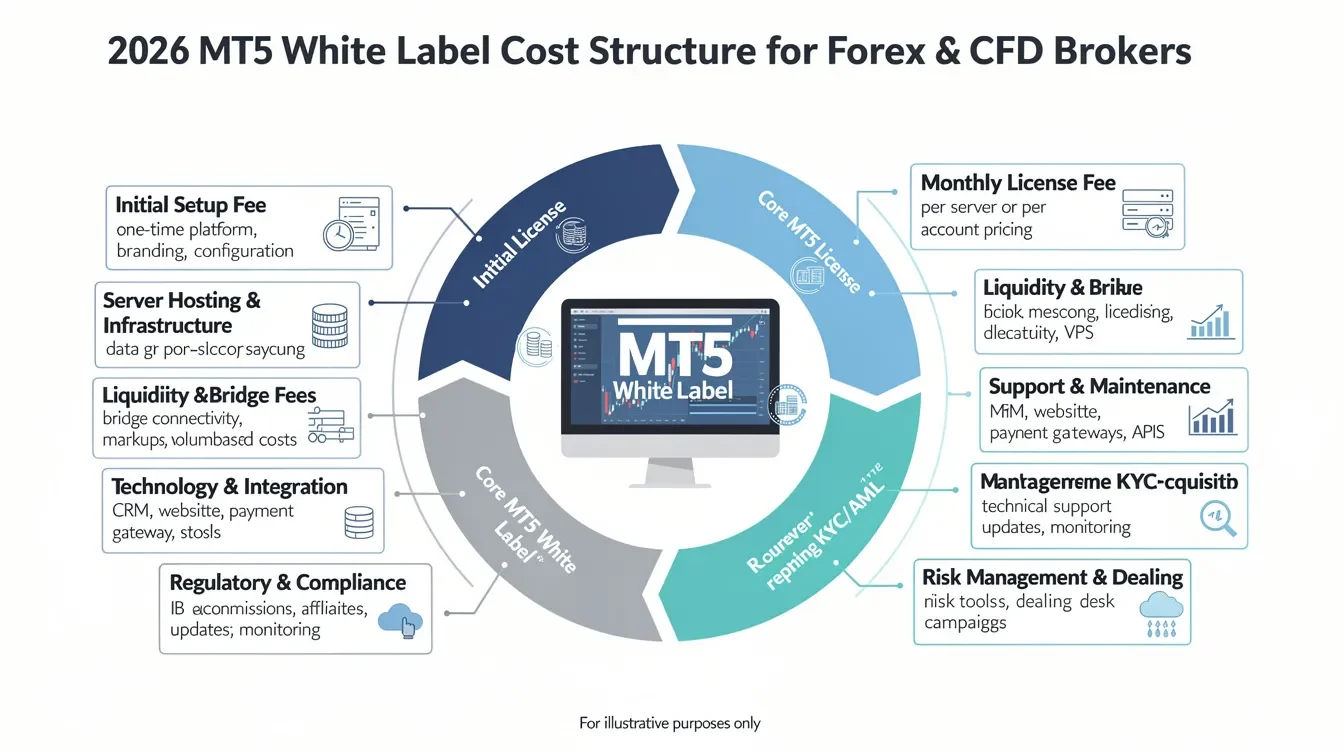
The following table presents planning-level ranges for 2026, drawn from vendor publications (B2Broker, Quadcode, Finxsol). These are budgeting anchors, not quotations. Setup fees range from USD 5,000 to USD 15,000, while monthly technology fees typically range from USD 1,000 to USD 3,000 for the platform component alone.
| Line Item | One-Time (USD) | Monthly (USD) | What Meters the Number |
|---|---|---|---|
| MT5 White-Label Setup | 5,000–15,000 (up to 30,000) | – | Server configuration scope, symbol groups, bridge setup |
| Branding & UI Customisation | 500–2,000 | – | Custom skins, mobile compatibility, app-store publishing |
| CRM Integration | 1,000–3,000 | – | Number of workflows, IB hierarchy depth |
| Liquidity Bridge Setup | 1,000–5,000 | – | Number of liquidity providers, A/B-book complexity |
| Platform Licence Fee | – | 1,000–5,000 (to 8,000) | Active-account tiers, hosting, ongoing maintenance |
| Liquidity & Data Feeds | – | 500–3,000 | Feed count (FX, stocks, futures), latency, depth |
| CRM Software | – | 500–2,000 | SaaS seats, reporting, crm systems complexity |
| Support & Maintenance | – | 200–1,000 | SLA level, update frequency, technical support |
| Server Hosting | – | 500–2,500 | Data-centre location, redundancy, bandwidth |
| PAMM / MAM / Copy-Trading Plugins | – | 300–1,000+ per plugin | Concurrent users, scalability |
| Risk-Management Plugins | – | 500–1,500 each | Real-time exposure, automated stop-outs |
| Outsourced Compliance Consulting | – | 2,000–5,000 | Jurisdiction, KYC/AML volume, reporting obligations |
These ranges imply total one-time outlay of roughly USD 7,500–25,000 and an all-in monthly run rate of approximately USD 2,700–11,000. MT5 white label provides liquidity connectivity for brokers and risk management tools are included in most packages, but the table separates fee expenses (licence, plugins), operational SaaS (CRM, server hosting) and advisory services (compliance). Working-capital items such as liquidity-provider deposits or payment-service reserves are excluded from these figures.
Why the Headline Platform Fee Misleads
Many white label providers lead with a headline figure – “MT5 white label from USD X per month” – that covers only the narrowest component of the technology stack: access to the MetaTrader 5 environment and basic hosting. It typically excludes bridge connectivity fees, risk plugins, enterprise-grade hosting at Equinix LD4 or Equinix NY4, advanced reporting, CRM, and regulatory tooling.
- A platform quoted at USD 5,000 per month realistically reaches USD 9,000–12,000 per month once liquidity-bridge fees of USD 1,000–2,500 per month, risk-management plugins, and low-latency colocation hosting of USD 1,000–5,000 per month in financial data centres are added.
- Liquidity costs may involve markup-based or volume-based fees. Many liquidity providers set minimum monthly-volume fees around USD 1,000–5,000, which can significantly affect the cost per ticket for smaller forex brokers and cfd brokers with lower trading volumes.
- PSP reserves and liquidity deposits represent working capital rather than fee expense. Payment service providers commonly hold 5–15 per cent of monthly processing volume as a chargeback reserve, tying up USD 25,000–75,000 where monthly card and e-wallet volume reaches USD 500,000. This does not appear on a P&L statement, but it constrains cash available for operations.
Relying solely on the headline platform fee for budgeting produces a materially incomplete picture of the actual setup costs and ongoing cost structure.
How the Meter Actually Works: Active Accounts, Not Demo Volume
Interactive · planning ranges, not quotes
MT5 White Label True Cost Meter
The quoted platform fee is one line on the bill. Set the account base and package tier, then mark each operating component as bundled by the principal or invoiced separately — the bar shows how far the real monthly figure drifts from the headline.
Inputs
Operating components
Monthly bill, assembled
Illustrative model built from published 2026 vendor planning ranges, not quotations. MetaQuotes does not publish a rate card and negotiates individually; account-tier scaling is modelled, and every real arrangement differs by jurisdiction, asset class and volume commitment.
MetaQuotes pricing scales with the number of active accounts on a licence; demo accounts are not charged (TradeInformer, September 2024). This detail reshapes cost planning.
Under a sub-licence structure, the principal negotiates account bands with MetaQuotes – typically stepping through tiers such as 0–1,000, 1,001–5,000 and 5,001–10,000 active accounts – and passes those tiers through to white-label operators. Every additional funded, trading account can push the brokerage into a higher MetaQuotes tier, increasing both the principal’s bill and the sub-licence pricing. MetaQuotes does not publish a rate card; terms are negotiated individually.
For a standard forex brokerage or cfd brokerage, this model aligns technology cost with revenue-generating activity. Long-tail inactive accounts remain relatively inexpensive to maintain if reclassified as dormant.
The model is challenging for prop firms. Prop trading firms frequently run thousands of demo-based evaluation accounts, but since MetaQuotes charges only for active live accounts, such structures generate minimal billable activity for the platform, bridge or liquidity provider. This mismatch leads providers either to apply different commercial terms or to move prop coverage onto alternative platforms such as cTrader, Match-Trader, DXtrade or TradeLocker – all of which sit outside MetaQuotes licensing constraints.
The Compliance Gate Money Does Not Open
Even a broker prepared to pay for an MT5 main licence or sub-licence must pass MetaQuotes’ tightened onboarding checks. Budget alone does not resolve this gate.
Reported MetaQuotes requirements include: documentation confirming the company may conduct financial services in its jurisdiction; a recent Certificate of Good Standing or Certificate of Incumbency for companies older than six months; a certified bank-reference letter carrying the company registration number and registered address; domain-ownership proof registered in the company’s full name; and verification of the individuals behind the brokerage. MetaQuotes also verifies telephone number, email, website and domain ownership. The set of acceptable registration jurisdictions narrowed sharply; Saint Vincent and the Grenadines remained one of the few viable for some models (Match-Trade Technologies, 2021; Centroid Solutions chief executive Cristian Vlasceanu, via Finance Magnates).
Regulators such as the FCA, CySEC and ASIC, plus local laws governing KYC/AML, GDPR and client-fund handling, sit on top of MetaQuotes’ own checks. Brokerages should ensure compliance with regulations even when using a white label solution. Brokers need a forex broker license or equivalent authorisation to operate legally, and compliance with GDPR is required for EU clients. AML and KYC procedures must be implemented for client verification. Client funds must be held in segregated accounts as required by regulators. Data hosting locations must comply with local laws for brokers serving regulated markets.
Vlasceanu reported that the corporate-bank-account requirement derailed some launch plans, forced firms to re-domicile into more established jurisdictions – costing time and additional capital – and pushed others to alternative trading platforms not constrained by MetaQuotes rules. Roughly 65 per cent or more of new market entrants still deploy on a white-label basis, but the regulatory and banking gate now determines which right trading platform and which jurisdiction are realistically viable.
The Operating Layer: CRM, Client Portal, Payments and Back Office
The non-terminal costs often exceed the MT5 platform fee itself. Most MT5 white-label packages provide basic account structures and dealing tools; serious forex and cfd brokers still need a brokerage CRM, a client area, IB and affiliate tracking, KYC verification and payments orchestration. Additional costs may apply for advanced CRM features, and many brokers seek alternatives to fragmented third party solutions due to operational complexity.
CRM software typically costs USD 500–2,000 per month for client management, IB tracking and reporting.
KYC verification checks run approximately USD 0.50–5.00 each depending on provider and depth.
Outsourced compliance consulting commonly costs USD 2,000–5,000 per month, absorbing time from compliance teams.
MT5 white label solutions include client onboarding automation in some packages, but payment-service reserves of 5–15 per cent of monthly processing volume tie up working capital – USD 25,000–75,000 at USD 500,000 monthly volume. This is working capital, not fee expense, and underscores the importance of designing the right payments stack for your brokerage.
WxTrade is a broker technology platform for launching and running forex and CFD brokerages – CRM, client portal, back office and payments in one environment. WconneX, the CRM within the WxTrade platform, supports workflows such as onboarding, KYC/AML, IB management and retention, helping broker teams manage operational efficiency without investing heavily in fragmented SaaS subscriptions. WxTrade’s open API marketplace helps technology teams integrate terminal data from whichever trading platform they adopt into a unified operating stack, supporting multi language support and api access for custom development.
In practice, the operating layer determines the real cost and operational complexity of scaling. A cheap MT5 white label paired with fragmented CRM and payment systems can prove more expensive than an integrated SaaS brokerage infrastructure designed for sustainable growth and cost efficiency.
Route Comparison: Sub-Licence, Own MT5 Server or Build
Three strategic routes exist in 2026 for firms seeking MetaTrader 5-level capability. Brokers can launch an MT5 white label in as little as 2–4 weeks, whereas alternative routes demand significantly more time and capital, making it critical to understand how to choose between white-label and full-stack brokerage paths. A full MT5 server license can cost over USD 100,000 in the first year. Some brokers prefer alternatives for better branding and customization options, while modern MT5 alternatives support multi-asset trading beyond forex. Panda Trading Server, for example, offers a fully integrated brokerage infrastructure as one such alternative.
| Dimension | Sub-Licence (MT5 White Label) | Own MT5 Server (Main Label) | Proprietary Build |
|---|---|---|---|
| Setup Cost | USD 7,500–25,000 | ~USD 30,000 (three months advance) | Upwards of USD 500,000 |
| Monthly Technology | USD 2,700–11,000 | USD 10,000+ licence, plus hosting and admin | Ongoing dev, hosting, staffing |
| Year-One Technology | USD 50,000–120,000 | USD 150,000–300,000 | Highly variable; typically exceeds USD 500,000 |
| System Administration | Handled by principal | USD 60,000–150,000/year (in-house or managed) | Full engineering team required |
| Time to Launch | 4–8 weeks | 2–6 months | 9–18 months |
| Server Control | Limited; no admin-server ownership | Full; root access, managing servers directly | Total ownership |
| Liquidity Integrations | Via principal’s liquidity access | Direct access to any liquidity provider | Custom bridge connectivity |
| Client Data Ownership | Often resides on principal’s systems | Operator owns server infrastructure and data | Full ownership |
| Greater Control | No | Yes | Yes |
Exit Costs and Data Ownership: The Hidden Cost of Entry
Migration cost should be treated as part of the original MT5 white-label business model, not as a future problem.
Switching MT5 white-label providers later is estimated to cost USD 30,000–80,000 plus 60–90 days of operational distraction on one published estimate, and USD 40,000–120,000 plus 60–120 days on another (Turnkey Inside, 2026).
These figures cover exporting and re-importing client accounts and trade history, reconfiguring dealing and risk-management plugins, re-integrating liquidity bridges, synchronising CRM and client-portal data, rebuilding IB hierarchies, and rebranding marketing materials and client communications.
Under many white-label structures, the principal controls not only the MetaTrader 5 licence but also some or all PSP and liquidity-provider contracts, and in some cases the primary database for client and introducing-broker data.
Practice tip: Raw client, trade and IB data export rights should be negotiated and documented contractually from day one, specifying formats, timing and any fees. IB tracking and affiliate tracking are generally safer when kept on infrastructure owned by the brokerage – for example within a platform such as WxTrade – rather than held solely on the principal’s systems. Conduct test exports prior to go-live, following a structured brokerage CRM migration playbook.
Total Cost Scenarios: Year-One MT5 White Label Economics
Three stylised first-year scenarios, based on the published ranges:
- Low-end: USD 7,500 one-time plus twelve months at USD 2,700 = USD 39,900
- Typical: One-time and monthly fees landing within USD 50,000–120,000
- High-end: USD 25,000 one-time plus twelve months at USD 11,000 = USD 157,000
For comparison, a main-label MT5 Server deployment typically costs USD 150,000–300,000 in first-year technology spend, plus an MT5 system administrator or managed service at USD 60,000–150,000 per year. Full MT5 server licenses can cost well over USD 100,000 in the first year alone.
These figures exclude regulatory capital, staff costs, marketing and working-capital items such as liquidity-provider deposits and payment-service reserves. The 20–25 per cent MetaQuotes price increase from January 2025 reduces the historical gap between white labels and full-server models, making a dedicated licence cost-efficient for brokers expecting rapid active-account growth and key advantages in control.
Buyer’s Checklist: What to Get in Writing Before Signing
In 2026 the main financial risks sit in contract wording around accounts, data and bundled support services, not only in the published platform fee. Before committing to any technology provider, broker teams should secure clarity on:
- Active-account definition: The precise billing trigger, dormancy rules and any minimum monthly fees.
- Data ownership: Contractual rights to export full client, trade, IB and ledger data in standard formats – during the contract and at termination – including any associated fees.
- Bundled vs excluded: Which components are included (platform, bridge, CRM, server hosting, technical support) and which incur separate charges (PAMM, MAM, copy trading, risk plugins, mobile trading applications, extra data feeds).
- Liquidity connectivity: Whether the principal mandates specific liquidity providers, minimum monthly-volume charges, and whether the brokerage can bring its own liquidity connections later.
- Compliance support: What KYC/AML tooling is included, automated reporting for regulators such as FCA, CySEC or ASIC, and whether outsourced advisory is bundled or a separate retainer.
- Termination and migration: Notice periods, early termination fees, migration assistance, server-side configuration exports if moving to an own-licence or alternative platform.
- Cost pass-through: How the provider’s own MetaQuotes costs are structured post-2025 and how future price changes flow through to the operator, with what notice and whether caps apply.
FAQ
Which white label forex platforms are best for brokers that need CRM, client portal, and payments included?
MetaTrader 5 itself focuses on the trading terminal and does not bundle CRM, client portals or payment systems. Several vendors package MT5 access with operational layers, but many brokers find those bundles inflexible. Operating-layer platforms such as WxTrade centralise CRM, client area, back office and payments while connecting to MT5, cTrader or Match-Trader via open APIs, helping broker teams avoid fragmented infrastructure and double data entry across disconnected crm systems.
What are the top white label brokerage solutions for launching a forex or CFD broker?
Most launches in 2026 still involve MetaTrader 4 or MetaTrader 5 under a sub-licence model, reflecting proven technology and trader preferences in the forex industry. Alternative platforms such as cTrader, Match-Trader, DXtrade and TradeLocker are increasingly selected to avoid MetaQuotes licensing constraints. Many firms pair their chosen terminal with a SaaS operating layer like WxTrade for CRM, client portals and KYC/AML to reduce technical complexity and improve operational efficiency.
What are the best CFD trading platform options for brokers offering white-label forex and CFD trading?
MetaTrader 5, cTrader, Match-Trader, DXtrade and TradeLocker are among the widely deployed multi-asset trading platforms for CFD brokers, each supporting white-label structures through different vendors. The practical decision typically turns on licensing terms, integration with existing CRM and payment systems, mobile compatibility, asset classes offered, and the broker’s target market rather than retail feature lists.
What aspects of a SaaS trading platform can brokers typically customize to match their brand?
SaaS broker platforms commonly allow custom branding of client-portal interfaces, colour schemes, typography, company logo placement, email templates and onboarding flows, together with configuration of account types, instruments and margin policies. WxTrade includes a platform-builder layer designed for such brand customisation while keeping core security, KYC/AML and reporting controls standardised – supporting brand identity without custom development overhead.
How long does it take to go live with an MT5 white label compared with a full MT5 Server licence?
MT5 white-label launches typically complete in about 4–8 weeks once legal and banking arrangements are ready. Brokers can launch a brokerage in as little as 2–4 weeks in optimal conditions. Deployments on a dedicated MT5 Server often take around 2–6 months due to infrastructure design, risk setup and regulatory approvals. Building a proprietary trading platform generally requires 9–18 months before live trading.
Is MT5 White Label still available directly from MetaQuotes in 2026?
MetaQuotes removed its MT5 White Label product from its app store in late September 2022 and has not resumed new white-label issuance since. New brokers therefore access MT5 under their own brand either by renting a sub-licence from an existing main-label holder or by obtaining a full MT5 Server licence, subject to MetaQuotes’ tightened compliance checks.
How should brokers budget for working capital alongside MT5 white label fees?
Beyond platform and SaaS monthly fees, brokers typically reserve capital for liquidity deposits, payment-service-provider reserves of about 5–15 per cent of processed volume, regulatory capital under licences from authorities such as FCA, CySEC or ASIC, and initial marketing spend for client acquisition. Brokerages that hold client funds must maintain segregated accounts. These items do not appear in MT5 white-label quotes but are critical to sustainable operations and long-term business growth.
Conclusion
MT5 white label cost in 2026 effectively means the total cost of renting a sub-licence under another firm’s MetaTrader 5 main label and assembling the operating stack around it – not simply a MetaQuotes list price. Cost curves are driven by active-account counts, the 2025 MetaQuotes price uplift, and the breadth of CRM, client-portal, payments and compliance tooling chosen. WxTrade is a broker technology platform for launching and running forex and CFD brokerages – CRM, client portal, back office and payments in one environment – and pairing such an operating layer with whichever trading terminals are selected can stabilise total cost of ownership. Broker founders and technology buyers should map projected active-account growth and operating-layer requirements over the first year before committing to any MT5 white-label or main-label contract, and consider engaging specialist vendors such as WxTrade for the non-terminal infrastructure.
.webp)