- Category: Industry Insights & News
Order and Execution Explained: Order Types, Execution Modes and What a Broker Runs Behind Every Fill
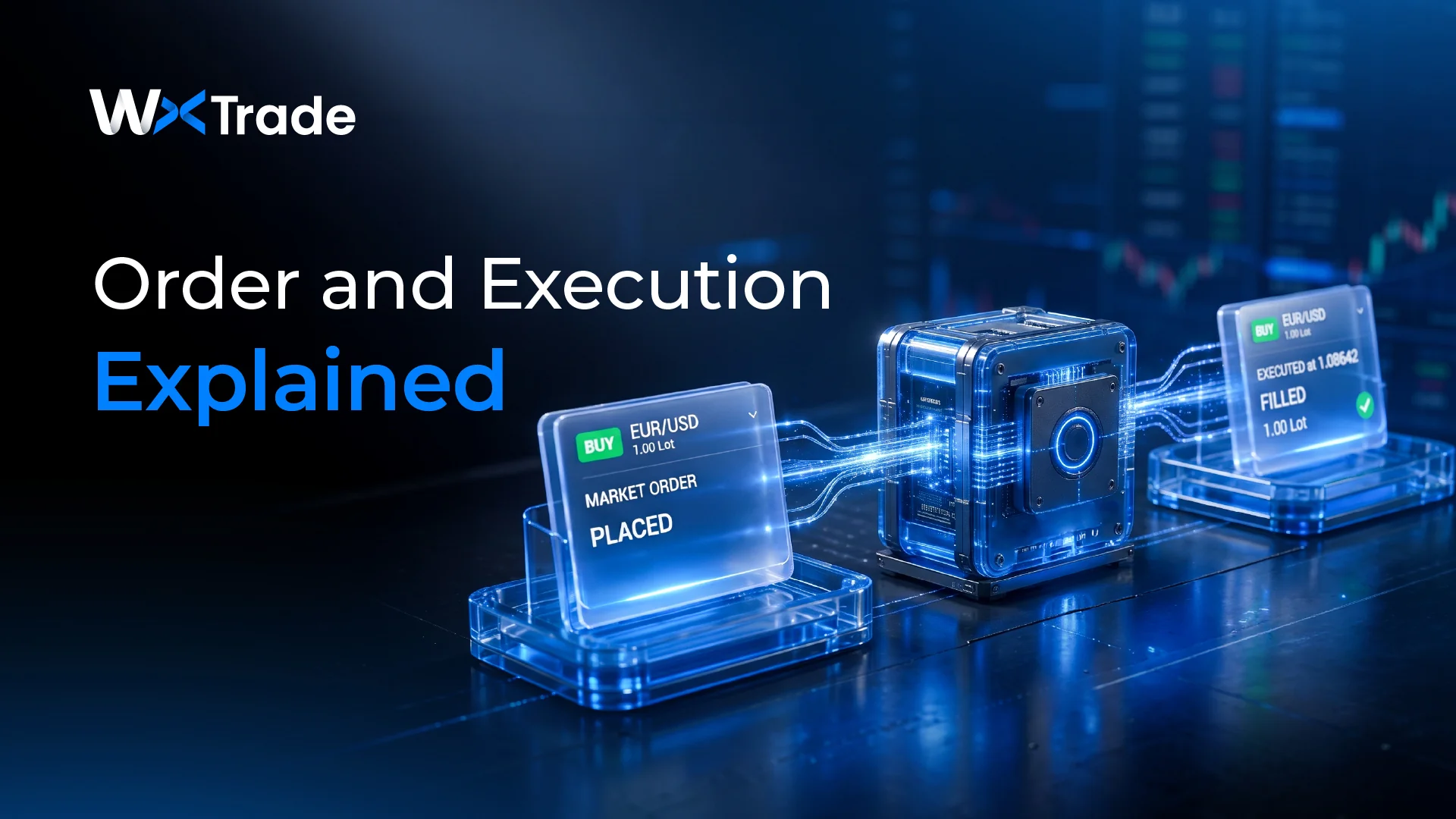
Order execution is the process that turns a trading instruction into a completed trade. The trading platform sends the order to the broker's trade server, the server checks it against the price, the account's available funds and the instrument's trading rules, and the order is then filled, rejected or left waiting. A filled order becomes a deal, and the deal opens, changes or closes a position. Two settings decide what the trader receives. The order type sets the condition: fill now (a market order), fill only at a set price or better (a limit order), or act once a trigger price is reached (a stop or stop-limit order). The execution mode sets what happens when the price moves between the click and the fill: under market execution the order fills at the new price, a difference known as slippage, while under instant execution the server can refuse the order and offer a new price, known as a requote. Every fill also sits under a best-execution duty, which requires the broker to seek the best result reasonably available for the client.
What happens between the click and the fill
An online trading account does not connect a trader directly to the market. According to Investor.gov, the investor education site of the U.S. Securities and Exchange Commission (SEC), the order goes to the broker, which decides where it is executed, and execution takes time: by the time the order reaches the market, the price could be slightly or very different from the one on screen.
The MetaTrader 5 user guide published by MetaQuotes sets out the same sequence from the trading platform's side. Its general scheme of trading operations runs in six steps:
- Send. The platform sends the order to the broker with its symbol, volume, type, price and any stop loss or take profit level.
- Check. The trade server checks the order, including whether the price is correct and whether the account has the funds to cover it. An order with incorrectly set stop loss or take profit levels is refused with an "Invalid stops" message.
- Queue. An order that passes the check waits to be processed on the trade server.
- Decide. The order is executed, automatically or by a dealer; rejected, for example when the money on the account is not enough or there is no suitable offer in the market; cancelled by the trader; or cancelled when it expires.
- Fill. Execution produces a deal. One order can produce several deals when its volume is filled in parts.
- Book. The deal opens a position or changes an existing one. On a netting account it increases, reduces, closes or reverses the single position in that symbol; on a hedging account each new deal opens a separate position. The broker sets which system an account uses.
Three words in that sequence are easy to confuse. MetaQuotes defines an order as the instruction to buy or sell, a deal as the exchange itself, with buys executed at the ask and sells at the bid, and a position as the resulting obligation in the instrument. A broker's reports reconcile all three: the order the client placed, the deals that filled it and the position that remains.
Between the check and the fill sits the routing decision: whether the order is passed to a liquidity provider, kept against the broker's own book, or split between the two. That choice, including A-book, B-book and hybrid models, is covered in a separate guide to smart order routing as the execution engine behind a broker's P&L.
Order types: what each one fixes and what it leaves open
Every order type trades certainty of price against certainty of execution. According to Investor.gov, a market order "guarantees that the order will be executed, but does not guarantee the execution price"; a limit order executes only at a specific price or better, so a buy limit fills at the limit price or lower and a sell limit at the limit price or higher; and a stop order becomes a market order once the stop price is reached. A buy stop sits above the current price and a sell stop below it.
The stop-limit order closes the gap the stop leaves open. The MetaTrader 5 help describes it as a combination of a stop and a limit order: when the price reaches the stop price, a limit order is placed, which caps slippage but leaves the order unfilled if the price has already moved beyond the limit.
Read across the four types, three points decide the outcome:
- Market and stop orders fill, at whatever price the market offers at that moment.
- Limit and stop-limit orders protect the price and may never fill.
- A stop loss is a stop order attached to an open position, so it carries the same gap risk.
| Order type | What the trader fixes | What can change before the fill | What it gives up |
|---|---|---|---|
| Market order | Direction and size | The price, which can move between the click and the fill | Certainty of price, in return for near-certain execution |
| Limit order | A price: buy at or below it, sell at or above it | Whether the market reaches that price at all | Certainty of execution; it never fills worse than the limit |
| Stop order | A trigger: buy above the market, sell below it | The fill after the trigger, which can be worse in a fast market or a gap | Certainty of price once triggered |
| Stop-limit order | A trigger and a worst acceptable price | Whether the price stays inside the limit after the trigger | Certainty of execution, in return for capped slippage |
Platforms name the pending versions by direction. MetaTrader 5 uses six: Buy Limit, Sell Limit, Buy Stop, Sell Stop, Buy Stop Limit and Sell Stop Limit. Stop loss and take profit are levels attached to an open position, and MetaQuotes notes that they trigger only for open positions, not for pending orders. Because a stop loss is filled as a market order, it is a trigger rather than a guaranteed price, a point worked through in the guide to risk management rules for stops, margin and stop-outs.
Two more instructions travel with a pending order. Its validity sets how long it stays live, from good till cancelled to a set date. Its fill policy sets what happens when the full volume is not available at once: according to MetaQuotes' MQL5 reference, Fill or Kill (FOK) executes the order only in its full volume, Immediate or Cancel (IOC) executes the volume available and cancels the rest, and Return keeps the unfilled remainder working. Whether each policy can be used is decided on the trade server.
Market execution vs instant execution
The execution mode is a property of each instrument, set by the broker, and it decides who carries a price change that happens while the order is in transit. MetaQuotes lists four modes and notes that the mode in use depends on the instrument type and the broker. Two of them, instant and market execution, explain the difference between a requote and a slipped fill.
- Instant execution protects the price: when the price moves too far, the trader gets a requote instead of a fill.
- Market execution protects the fill: any price change, better or worse, shows up as slippage.
- Request execution quotes a price before the order is sent, and exchange execution fills against the offers on the venue.
| Mode | Who sets the price | If the price moves in transit | What the trader sees |
|---|---|---|---|
| Instant execution | The platform attaches the current price to the order | Inside the trader's deviation it fills at the new price; beyond it the server can refuse and quote again | A fill, or a requote to accept or reject |
| Request execution | The broker quotes on request, before the order is sent | The quote stays valid for a few seconds | A price, then a choice to buy or sell at it |
| Market execution | The broker, without further discussion with the trader | It fills at the broker's price, better or worse than the screen | A fill whose price may differ from the screen |
| Exchange execution | Current offers on the trading venue | It fills against the offers available | A fill under the order's fill policy |
Under instant execution, the platform adds the current price to the order. If, while the order is processed, the price changes by more than the amount in the trader's "Deviation" field, the dealer or server can refuse the order and offer new prices, which stay valid for a few seconds. Within the deviation, the order is executed at the new price without any notification. A wider deviation therefore means fewer requotes and more tolerated slippage; a narrower one means the reverse.
Under market execution, MetaQuotes states that sending the order "means advance consent to its execution at this price", the price the broker decides without going back to the trader. The fill price simply differs from the screen when the market has moved. Fill policies follow the mode as well: the MQL5 reference states that Return orders are not allowed in market execution mode.
Slippage and requotes, worked through
Slippage is the difference between the price a trader expects and the price at which the order fills. A requote is the instant-execution alternative: instead of filling at a different price, the server stops and asks. Both come from the same event, a price that moves while the order is in transit, and the broker's settings decide which one the trader sees.
Take a buy of 100,000 euros of EUR/USD, one standard lot, with an ask of 1.08500 on screen. Before the server prices the order, the ask moves two pips to 1.08520. One pip on this position is worth 10 US dollars (100,000 × 0.0001), so the move costs 20 US dollars on any order that fills at the new price. Pips, lots and their values are defined in the forex trading definitions guide. For the two pending orders in the table, the expected price is the stop level, and the ask jumps from below it straight to 1.08520. The same two-pip move ends five different ways:
| Order and setting | What happens | Fill price | Against the expected price |
|---|---|---|---|
| Market order, market execution | Fills at the new price | 1.08520 | 2 pips, USD 20 worse |
| Market order, instant execution, 3-pip deviation | Fills at the new price without notice | 1.08520 | 2 pips, USD 20 worse |
| Market order, instant execution, 1-pip deviation | Requote at 1.08520; the trader accepts or rejects | 1.08520, only if accepted | No trade until accepted |
| Buy stop at 1.08500, ask jumps through it | Triggers and fills at the next price | 1.08520 | 2 pips, USD 20 worse |
| Buy stop-limit, stop 1.08500, limit 1.08510 | A buy limit is placed, but the ask is already above it | No fill | The order waits for the ask to return to 1.08510 |
The prices are illustrative, and the mechanics run in both directions: had the ask fallen two pips instead, the market-execution buy would have filled two pips below the screen. The simulator below runs the same buy across order types, execution modes, deviations and limit distances.
Execution simulator
One price move, five ways an order can end
A buy of 100,000 euros of EUR/USD. The reference price is 1.08500: the ask on screen for a market order, or the trigger or limit price for a pending order. Move the ask before the fill and see what the trader gets.
- Send
- Check
- Price
- Filled
Order
Execution mode applies to orders sent at the market. A pending order is executed by the server when its price is reached.
Result
FilledMarket execution fills at the broker's price. The ask rose 2.0 pips in transit, so the buy filled 2.0 pips above the screen price: negative slippage.
Illustrative prices. One pip on 100,000 euros of EUR/USD is worth 10 US dollars. Whether a server requotes or fills within the deviation, and which modes an instrument uses, are broker settings.
Best execution: the duty behind every fill
In the European Union, Article 27 of the Markets in Financial Instruments Directive (MiFID II) requires investment firms to "take all sufficient steps to obtain, when executing orders, the best possible result for their clients", taking into account price, costs, speed, likelihood of execution and settlement, size, nature and any other relevant consideration. For a retail client, the best possible result is judged on total consideration: the price of the instrument plus all costs directly related to executing the order.
The UK sets the same standard in the Financial Conduct Authority (FCA) Handbook at COBS 11.2A, which also requires a firm to establish an order execution policy and to review that policy and its execution arrangements at least once a year. In the United States, Investor.gov describes a broker's "duty to seek the best execution that is reasonably available for its customers' orders": the broker evaluates the orders it receives from all customers in the aggregate and periodically assesses which competing markets, market makers or electronic communications networks offer the most favourable terms.
The standard is therefore a process rather than a promise about any single fill: a policy, the monitoring that shows whether it works, and the records behind both. Some brokers publish the results. Saxo, for example, publishes monthly FX execution statistics for its most traded currency pairs, covering price improvement, fill rates and execution speed, with separate figures for market, limit and resting stop orders. The venues a broker routes to are judged on the same factors, and the guide to choosing a forex liquidity provider sets out how their execution costs are compared.
What the broker configures behind every fill
Much of what a trader experiences as execution quality is a set of per-instrument settings on the broker's side. For a MetaTrader 5 symbol, the MQL5 symbol reference lists, among others:
- Execution mode: request, instant, market or exchange.
- Trade mode: whether the symbol is fully tradable, limited to long or short positions, limited to closing positions, or disabled.
- Stops level: the minimum distance from the current price at which stop orders can be placed.
- Freeze level: the distance from the price within which trade operations are frozen.
- Filling mode: which fill policies orders on the symbol can use.
Each order also records the reason it was created. The MQL5 reference distinguishes orders placed from the desktop terminal, the mobile application or the web platform, by an Expert Advisor or script, and by the activation of a stop loss, a take profit or a stop out. That field lets a dealing or support team separate a client's own close from one the server generated when a fill is disputed.
In WxTrade's back office, the Symbols screen lists each instrument with its execution setting next to its digits and instrument type, and the Orders screen shows each pending order by type beside the current market price and the reason that created it. Together the two screens show an operations team what is configured on each instrument and what is waiting to trigger.
Frequently asked questions
Can a broker get a better price than the market price for a client?
Yes, and the result is called price improvement. Investor.gov describes it as "the opportunity, but not the guarantee, for an order to be executed at a better price than the current quote", and notes the trade-off a broker has to weigh: the additional time some markets take to execute orders can also produce a worse price than the current quote in a fast-moving market.
How long do pending orders remain active?
Until their validity runs out, or until they are cancelled or rejected. The MQL5 reference lists four validity settings: good till cancelled, good for the current trading day, good until a set expiry time, and effective until 23:59:59 of a specified day. When that time falls outside a trading session, the order expires at the nearest trading time.
What factors can influence trade execution?
Size, venue and timing. Investor.gov points out that price quotes are valid only for a specific quantity, so an order may not receive the price seen on screen; that where and how an order is executed can change the overall cost of the transaction; and that SEC regulations do not require a trade to be executed within a set period of time. On forex and CFD platforms, the instrument's execution mode and the trader's deviation setting then decide whether a price change becomes slippage or a requote.
Are brokers required to provide the best order execution available?
They are required to seek it, not to guarantee it on every order. The EU text adds an exception: where a client gives a specific instruction, MiFID II requires the firm to execute the order following that instruction. In the United States, Investor.gov notes that a client who wants an order sent to a particular exchange, market maker or electronic communications network may be able to ask the broker to do so, although some brokers charge for that service.
What does an order execution system do?
It carries an order through the steps described above: it validates the order, routes it, prices and fills it, confirms the result to the trader and records the order, the deals and the resulting position. When an operation is sent to an exchange or a liquidity provider, MetaQuotes notes that it also carries an identifier from that external system, which allows the operation to be tracked outside the trading platform.