- Category: Brokerage Business
Forex CRM Reporting and Automation Features for Brokerage Operations Teams
Introduction
Essential forex CRM reporting and automation features for brokerage operations include real-time client lifecycle tracking, automated compliance workflows, multi-platform data aggregation, and regulatory reporting pipelines. These capabilities form the operational backbone of any forex brokerage that must reconcile trading activity across MT4, MT5, cTrader, and DXtrade while satisfying regulators such as the FCA, CySEC, ASIC, and ESMA.
Platforms like WxTrade — a broker technology platform combining CRM, client portal and back-office workflows in one environment — demonstrate how these features converge in practice. A forex CRM connects trading platforms, payment systems, and compliance workflows, functioning as the central nervous system of brokerage infrastructure.
Forex CRM reporting connects customer relationship management data with live trading platform data, giving operations teams the visibility needed to act on accurate, timely information rather than retrospective spreadsheets. That alignment keeps reconciliation and regulatory submissions accurate as the brokerage scales.
This article focuses on the operational implementation of reporting systems within existing brokerages — not vendor selection. The target audience is heads of operations, back-office managers, compliance officers, and finance leads who already run a brokerage and need to understand how reporting and automation actually work at the infrastructure level. For readers at the evaluation stage comparing providers, a dedicated comparison resource covers that ground.
By the end of this article, operations teams will understand:
-
How to build a reporting matrix that maps each stakeholder to the data, cadence, and source systems they require
-
Which brokerage workflows can be automated and where automation boundaries demand manual oversight
-
How to detect and resolve data integrity issues, including reconciliation drift and dashboard inaccuracies
-
A practical framework for evaluating whether a reporting layer can be trusted
Understanding Forex Brokerage Reporting Architecture
A forex CRM centralises client data, enhancing operational efficiency — but reporting architecture extends well beyond simple contact management. Four core components define how data flows through brokerage operations.
The CRM data layer houses client profiles, lead sources, client onboarding and KYC status, trading accounts, funding status, IB affiliations, and interaction history. It must support field-level change history, role-based permissions, and audit trails. The trading platform integration layer ingests execution data — symbols, volume, entry/exit prices, swaps, commissions — from MT4, MT5, cTrader, and DXtrade via Manager APIs or bridge services. Forex CRMs integrate natively with MT4, MT5, and cTrader, and integration depth is crucial for real-time data synchronisation. Compliance engines manage KYC/AML workflows, sanctions and PEP screening, document verification, and risk scoring. Finally, financial reconciliation systems handle PSP integrations, deposit/withdrawal records, internal transfers, chargebacks, and net cash flow accounting.
These components feed directly into regulatory reporting requirements. Under MiFIR Article 26, investment firms must report transaction details — instrument identifiers, quantity, date/time, price, client identity — as quickly as possible and no later than the close of the following working day. EMIR reporting obligations cover derivative transactions submitted to Trade Repositories with Unique Transaction Identifiers (UTI) and Legal Entity Identifiers (LEI). MiFID II imposes additional requirements on systematic internalisers, transparency regimes, and instrument reference data.
Real-Time vs Batch Data Processing
Streaming data flows provide near-instant ingestion of trade executions, deposits, withdrawals, and KYC status changes. Real-time data analytics in forex CRM provide insights into deposits and active traders, enabling dealing desks and risk teams to react immediately to anomalies such as large drawdowns, margin breaches, or exposure spikes. Real-time data integration improves decision-making speed for brokerages. These pipelines require message queues or event bus architectures, schema versioning, and handling of out-of-order data.
Batch processing — hourly, nightly, or monthly jobs — suits heavier aggregations: regulatory submissions, ledger reconciliation, financial close reports, and monthly statements. Some regulatory deadlines demand near-real-time submission (MiFIR’s next-working-day rule), while others operate on monthly or quarterly cycles. Operations teams must design for both: streaming for internal risk monitoring and real time visibility, batch for external obligations and deeper aggregation. Real-time transaction monitoring is crucial for compliance, while batch processing handles the reconciliation and reporting that ensure financial operations remain accurate over longer periods.
Multi-Platform Data Aggregation
Brokers operating across multiple trading platforms face significant normalisation challenges. MT4/MT5 Manager APIs provide different data sets and formats from cTrader bridges; DXtrade introduces yet another API shape. PSP integrations vary in format, currency, and settlement period. Symbol naming conventions differ between platforms, time zones require standardisation (typically to UTC), and client identity mapping — trading account IDs versus CRM client IDs — demands a robust data model.
Integration patterns include direct API connectors, webhooks from PSPs, scheduled pulls, and message queues for streaming. A normalisation layer transforms platform-specific data into a unified schema covering instruments (ISIN, symbol), client identifiers, standardised timestamps, and consistent handling of partial fills, refunds, and reversals. Without this layer, reporting capabilities degrade as volume scales, producing the kind of operational friction that generates reconciliation errors and delayed regulatory submissions.
Core Reporting Audiences and Data Requirements
Different stakeholders within brokerage operations require fundamentally different views of the same underlying data. Effective forex CRM systems offer customisable dashboards for different user roles, but the architecture must first define what each audience needs, how frequently, and from which source systems.
Operational Reporting Matrix
| Audience | Report Types | Refresh Cadence | Source Systems |
|---|---|---|---|
| Management / Executive | Daily P&L summaries by platform/symbol, weekly revenue forecasts, partner channel performance, churn and LTV by cohort, sales pipeline metrics | Daily / Weekly | CRM module, trading platforms (MT4/MT5/cTrader), back office ledger |
| Compliance Teams | KYC funnel status, expired document summaries, sanctions hits, AML transaction monitoring logs, suspicious transaction reports, audit trail of approvals | Real-time alerts / Daily aggregation | Compliance engine, CRM data layer, document verification system |
| Dealing Desk / Risk | Open exposure by symbol, margin utilisation, large position breaches, net exposure per side, risk limits monitoring | Real-time / Streaming | Trading platforms, risk control module |
| Finance | PSP cash flows (deposits, withdrawals, fees), net cash vs platform P&L, currency conversion gains/losses, accounting reconciliations, multi currency wallet management balances | Daily / Monthly | PSP/payment gateways, back office ledger, trading platforms |
| IB Partners | Commission earned per period, pending payouts, overrides, clawbacks, agent performance by account/symbol/volume | Weekly / Monthly | IB management module, trading platforms, CRM |
Forex CRM reports track client lifecycle performance from lead acquisition to trading activity, and automated report scheduling allows regular data delivery to each of these audiences without an analyst rebuilding the same extract every week.
Regulatory Compliance Workflows
Ensuring regulatory compliance across multiple jurisdictions requires CRM systems to generate jurisdiction-specific outputs. The FCA demands UK MiFIR transaction reporting, instrument reference data (FIRDS), and client money/asset reports. ESMA oversees MiFIR/MiFID II, EMIR, and MAR across the EU. CySEC enforces MiFID II locally alongside its own AML framework. ASIC, MAS, and FSCA each impose analogous but distinct trade reporting, financial services licensing, and AML/KYC obligations — a spread that is easier to plan around once the brokerage’s licensing position is settled.
GDPR governs personal data collected via CRM and onboarding — lawful processing, secure storage, and client rights including access, erasure, and correction. Data retention policies must cover CRM logs, identity documents, and audit trails. ISO 27001 alignment requires controls around access management, encryption, admin rights, audit logging of user actions, protection of data at rest and in transit, and incident response. A forex CRM must enforce MFA, role-based and field-level permissions, and generate the audit logs needed for certification. Forex CRM systems integrate compliance workflows into operations, and automated compliance tools support adherence to these regimes — though the obligation itself remains the brokerage’s own.
Automation Capabilities in CRM Reporting Systems
Automation allows brokerages to scale without proportional headcount growth, but understanding which workflows can be automated — and which cannot — prevents the kind of failures that attract regulatory scrutiny.
Client Lifecycle Automation
Forex CRM automates KYC and AML processes for onboarding, covering document submission, identity verification, and status progression (submitted → under review → approved → rejected). Where identity documents are clean and the client profile is low-risk, a large share of submissions can clear without human intervention, and automated onboarding reduces client drop-off during registration. Expiry reminders trigger automated alerts to compliance teams when documents approach renewal dates.
Deposit/withdrawal reconciliation with PSP systems can be automated for routine transactions — small deposits, standard payment methods — while large or high-risk transactions require manual review with maker-checker controls. A forex CRM should support multi currency wallet management to handle transactions across multiple currencies and payment processing channels.
Dormancy identification follows configurable inactivity thresholds: a client inactive for 90+ days can be auto-marked as dormant, triggering retention workflows — reactivation emails, compliance team flags for risk assessment upon reactivation. Client onboarding includes risk profiling and compliance approval, and behavioural segmentation allows brokers to identify which cohorts merit re-engagement.
IB and Commission Automation
Forex CRMs automate commission calculations for Introducing Brokers across complex IB hierarchies, including multi tier structures with per-lot, per-symbol, and tiered override models. Automated commission calculations reduce errors in IB payouts — a critical concern when brokerages manage partner networks numbering in the hundreds.
Revenue share versus CPA model automation requires distinct logic: fixed CPA on first deposit versus percentage on spread or net revenue. Payout scheduling can be automated on weekly or monthly cycles with pending accruals and clawback rules. Partner portal data synchronisation ensures IB partners see updated dashboards showing volume, P&L, commissions outstanding, and automated payouts — supporting partner relationships through transparency.
Automation Boundaries Matrix
| Brokerage Workflow | What Can Be Automated | What Must Stay Manual | Failure Mode if Fully Automated |
|---|---|---|---|
| AML/Sanctions Screening | Initial sanctions/PEP checks, risk scoring, automated flagging | Ambiguous matches, high-risk customer reviews, subjective risk assessments | False negatives, missed matches, regulatory breach |
| Large Withdrawal Approvals | Rule-based auto-review for amounts under threshold, documentation requests | Amounts above threshold, additional documentation verification | Unauthorised or fraudulent large withdrawals if threshold misconfigured |
| Commission Disputes | Calculation verification, statement generation, audit trail retrieval | Partner disagreements, disputed cases, override decisions | Negative IB partner relationships, unresolved errors compounding |
| KYC Document Expiry | Expiry alerts, reminder emails, status changes, re-verification triggers | Edge cases, incomplete documents, regulatory judgement calls | Clients trading on expired documentation, compliance violation |
| Regulatory Submission | Data extraction, formatting, scheduled submission | Exception handling, correction submissions, regulator queries | Invalid reports submitted without human validation |
Forex CRM automates KYC processes, reducing manual workload — but the boundaries shown above illustrate why compliance teams and back office tools must retain human escalation paths.
Data Integrity and Reconciliation Challenges
Interactive · Data integrity
Reconciliation Drift Detector
The trading server is the truth. The CRM dashboard is a copy. Pick a refresh mode and watch how far apart the two drift on a normal trading day — and how long it takes anyone to notice.
Illustrative simulation of refresh-cadence lag on a single trading session. The amber marker is the tolerance threshold — the point past which variance stops being noise and starts being a reconciliation job.
As brokerages scale, reporting accuracy becomes the difference between operational confidence and regulatory risk. Validating sources and ensuring clean audit trails are essential for forex brokers.
Reconciliation Drift Between Systems
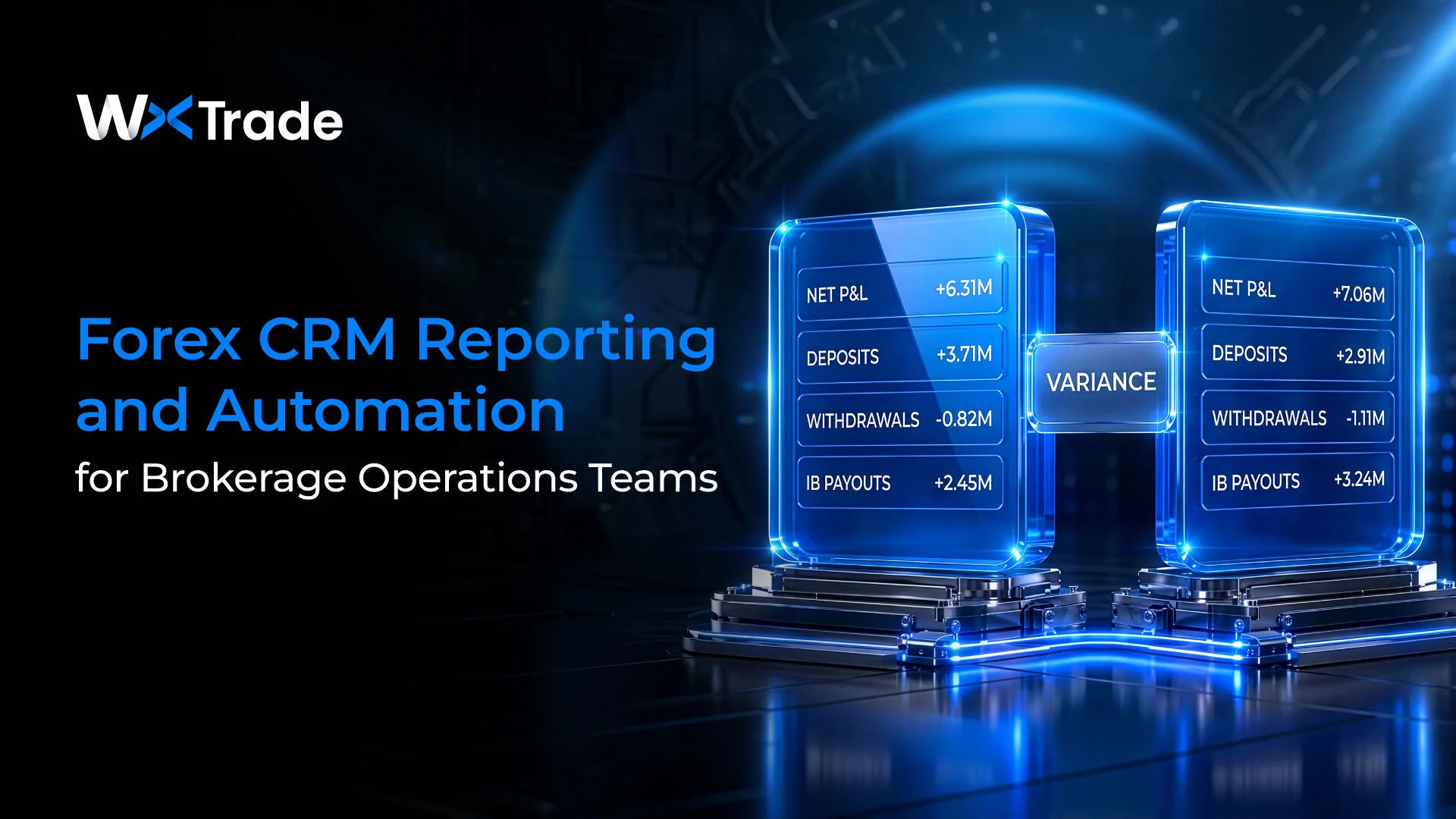
Common causes of drift between CRM and back office data include mismatched time zones, delays in trade execution versus platform feed ingestion, missing PSP transactions, discrepancies in symbol naming, rounding differences, partial fills not captured, and manual overrides. The impact ranges from inaccurate P&L and mis-paid commissions to wrong exposure reporting and compliance violations.
Operations teams detect drift by cross-referencing CRM reports against trading platform manager data and verifying MT4/MT5 API completeness. Practical detection methods include sampling random client accounts, comparing deposit/withdrawal logs against PSP statements, and checking ledger totals against platform P&L. Variance thresholds should trigger automatic alerts when discrepancies exceed acceptable tolerance levels. Forex CRM reporting aggregates and analyses trader behaviour and financial transactions — but that aggregation is only as reliable as the underlying data feeds.
Historical Data Restatement Procedures
When errors surface after a regulatory or financial report has been submitted — incorrect transaction reports, misrouted trades, mis-assigned IB commissions, mislabelled instrument reference data — a formal restatement procedure is required. This includes recording original values, new values, who changed them, and when. Restated reports must be marked, copies archived, and corrections explained to regulators or stakeholders. Audit trail requirements for regulatory purposes demand that every client action and system change is logged, with version control maintained in the reporting layer. Minimum retention periods for audit logs vary by jurisdiction and should be confirmed against the brokerage’s own licence conditions rather than assumed.
Dashboard Accuracy Monitoring
Dashboards showing “live” metrics based on stale or incomplete data create false confidence. Data ingestion failures, connector outages, missing PSP files, and misconfigured filters all contribute to quietly incorrect operational dashboards. Validation procedures include shadow reports that compare dashboard metrics against source systems directly, monitoring error rates on data pipelines, health metrics on connectors, and alerts when pipeline lag exceeds defined thresholds. Forex CRM reporting helps brokers track key performance indicators in real time — but only when the underlying data pipeline health is actively monitored. Risk monitoring is effective only if the feeds behind it are verified as complete and current.
Evaluating Whether a Reporting Layer Can Be Trusted
Operations teams need a practical framework to assess whether their current reporting infrastructure is reliable. Four dimensions matter: data source validation (availability, latency, completeness, and schema stability for each source — trading platforms, PSPs, CRM module, compliance engine); audit trail completeness (whether every change is logged with who, when, and what, including document events, financial events, client profile edits, and account state changes); refresh-cadence honesty (whether “real-time” truly means seconds or conceals minutes of lag, and whether “daily” reports cover full 24-hour windows across time zones); and reconciliation tolerance (defined acceptable discrepancy levels, frequency of reconciliation runs, and escalation procedures when drift exceeds tolerance).
Practical checks an operations team can run in a single working day:
-
Trace a single metric end-to-end — take total daily P&L from MT5, follow it from raw trade log through normalised feed to CRM dashboard to finance ledger, noting timing and variance at each stage
-
Sample client accounts — select several accounts with known trading history, verify that commission/IB payouts match what reports show
-
Test KYC document flows — find a client whose documents expired, confirm the system raised expiry warnings, and verify the audit trail logs the resulting action
-
Review connector health — check system logs for API errors, PSP exceptions, connector outages, and data gaps
Unified Platform Integration
WxTrade combines CRM, client portal and back-office workflows in one broker technology platform.
When CRM, trading platform data, payment/reconciliation systems, IB portals, and compliance engines live in disconnected tools, data silos generate the very reconciliation drift described above. Client IDs mismatch across systems, timestamps diverge, and states become inconsistent. A unified platform approach — where a CRM module such as WconneX, the CRM within the WxTrade platform, shares a data model with back office functions, payment processing, IB management, and compliance workflows — reduces these integration points. Shared schemas, consistent timestamps, and a single source of truth for client data simplify the reconciliation burden. Operational management benefits from fewer connectors to monitor, fewer normalisation layers to maintain, and a more reliable foundation for both real-time dashboards and batch regulatory submissions.
Conclusion and Implementation Steps
Forex CRM reporting and automation features serve as the operational infrastructure through which brokerage operations teams maintain regulatory compliance, financial accuracy, and partner trust. The reporting matrix defines who needs what data; the automation boundaries matrix defines where human oversight remains essential; and the data integrity framework determines whether the entire reporting layer can be trusted.
Immediate next steps for operations teams:
-
Audit current data flows — map every source system feeding into reports and identify latency, completeness gaps, and normalisation inconsistencies
-
Identify reconciliation gaps — run the single-day validation checks described above across P&L, IB commissions, and KYC document flows
-
Test automation boundaries — document which workflows currently run without human oversight and assess whether failure modes have been accounted for
-
Evaluate platform consolidation — assess whether disconnected operational workflows, CRM, and back office tools are generating avoidable drift
For brokerage operations teams seeking to reduce operational friction through a unified approach, WxTrade supports multi-platform trading, IB management, compliance workflow automation, reporting and analytics — designed for the workflows that forex specific solutions must address.
Frequently Asked Questions
What are the top forex CRM reporting and automation features for brokerage operations teams?
The essential features include real-time client lifecycle tracking (lead through to dormancy and reactivation), regulatory reporting pipelines (MiFIR, EMIR, MiFID II), multi-platform data aggregation across MT4, MT5, cTrader and DXtrade, audit trail generation, automated KYC progression and document expiry alerts, IB commission automation with automated commission calculations, PSP reconciliation, risk monitoring dashboards, and compliance workflow engines. Forex CRM reporting helps brokers track key performance indicators in real time, while automation clears routine, low-risk cases so that operations staff spend their time on the exceptions.
What forex brokerage platforms offer unified ecosystems and SaaS?
Unified brokerage platforms integrate trading platform integration, CRM, back office, client portal, IB management, and compliance tools within a single environment. WxTrade is one such platform, combining CRM (via WconneX, the CRM within the WxTrade platform), client portal, and back-office workflows to support forex and CFD brokerages. Key features to look for include native MT4/MT5/cTrader connectivity, integrated payment gateways, automated compliance workflows, and consolidated reporting capabilities — all accessible as specialised software rather than assembled from disconnected tools.
Which top broker CRM platforms offer strong back-office integration?
Strong back-office integration means the CRM module connects upstream trading data, PSP feeds, commission engines, and reconciliation systems without requiring manual data transfer. Modern forex CRMs that achieve this provide unified client profiles linked directly to trading accounts, automated deposit/withdrawal reconciliation, IB payout scheduling, and ledger synchronisation. The critical evaluation criterion is whether the CRM shares a native data model with back office tools or relies on external connectors that introduce latency and drift.
Our platform, CRM and back office are disconnected — is there one system that unifies trading, CRM and back office for a small broker?
A unified system for a small broker must support: integrated trading platform connectors (MT4/MT5/cTrader), a CRM module handling client onboarding, KYC, and lead management, and a back office with PSP integration, ledger, and IB engine. It should maintain a unified data model, audit trails, and role-based access. WxTrade is designed for this use case — it combines CRM, client portal, and back-office workflows in one broker technology platform, helping broker teams manage complex IB hierarchies, payment processing, and compliance without assembling multiple disconnected systems.
How do operations teams identify when CRM reporting data is inaccurate?
Signs include discrepancies between trade logs and dashboard totals, mismatches between PSP records and client balances, inconsistent timestamps across systems, connector error logs showing API failures, and missing data for specific time windows. Teams should routinely sample random client accounts to verify that trading history, commission payouts, and client information match across CRM, platform manager data, and finance ledgers.
What regulatory reporting can be fully automated vs requiring manual review?
Fully automatable: standard MiFIR transaction reporting (with stable schema), instrument reference data submission, KYC status expiry reminders, routine commission payouts, and PSP reconciliation for standard deposit types. Manual review required: large or high-risk transactions, exceptions or discrepancies flagged by automated screening, ambiguous KYC cases, subjective risk assessments, and responses to regulatory queries. Forex CRM automates KYC and AML processes for compliance, but human escalation paths remain essential for edge cases.
How should brokerages handle historical data corrections in regulatory reports?
Brokerages must maintain the original submitted values, log every correction with who made the change, when, and why, and restate the affected report. Copies of both original and restated versions should be archived. Regulators expect formal notification of corrections, and the audit trail must demonstrate version control. Subsequent internal reports — IB commissions, financial statements, client data records — must be adjusted to reflect the corrected data.
What are the signs that a brokerage has outgrown its current CRM reporting capabilities?
Key indicators include frequent reliance on manual spreadsheet merging, consistently delayed reports, a high rate of reconciliation issues, lack of real time visibility into trading activity or financial operations, inability to produce regulatory reports within required deadlines, IB partner disputes over commission accuracy, audit findings highlighting data gaps, and an inability to scale reporting with growing trade volumes without proportional headcount growth. When the brokerage infrastructure creates more operational friction than it resolves, it is time to evaluate whether the right forex CRM and reporting layer can support the next stage of growth.
.webp)